


Ask Claude which agency to hire, and the answer usually comes from the agencies themselves.
That is not an impression. It is a count. On 21 October 2026 we put the same Swiss SME questions to Claude, Anthropic's large language model, again and again, with web search switched on and the location set to Zurich. The result: 3,968 answers, 26,933 cited addresses and 884 different domains.
We know of no public figures on this for Switzerland. So we are publishing the full method and every number, including the ones that are uncomfortable for us.
Six numbers that matter
- 80.9% of cited addresses are company websites. Media, associations and universities account for 3.7%, public authorities for 2.7%.
- 38.9% of answers cite at least one directory or comparison portal; for brand and design questions it is 78.8%.
- 9.8% of answers cite the single most-cited domain. Half of all domain citations are spread across 100 domains.
- 37.4% of German-language answers to Swiss legal questions cite a .de source; in English it is 11.0%.
- 6.5% of answers to the two questions without a location triggered a web search. With a location it was 98.5%.
- 2.5% of answers mention ALPENIQ, almost all of them for a single question.
What we measured, and what we did not
This covers one platform: Claude through Anthropic's API, in two models. ChatGPT, Gemini, Perplexity, Google's AI Overviews and the Claude app are not part of it. Everything below describes this measurement.
| Item | Detail |
|---|---|
| Models | Claude Opus 5.5 and Claude Sonnet 5.5 |
| Questions | 36, each in German and English: 26 across five service areas, 6 on the Swiss legal framework, 4 about ALPENIQ |
| Analysed | 32 questions. The four that contain the name ALPENIQ are excluded because they give the answer away |
| Repetitions | Opus 24 times, Sonnet 38 times per question and language |
| Answers | 4,464 in total, 3,968 in the analysed set |
| Period | 21 October 2026, all answers within 2 hours 43 minutes |
| Settings | web search on with up to five searches per answer, location Zurich, no system prompt |
| Failures | no refusals, no truncated answers |
| Cost | about USD 338 for all 4,464 answers |
How we count. A domain is the address without subpages, so admin.ch stands for every federal office. It counts once per answer, however often Claude cites it. Fixed rules assign the source type: the domains of the federal government (admin.ch, ch.ch), the cantons, the City of Zurich and the EU mark public authorities, two hand-checked lists mark directories and media, and everything else counts as a company website.
A conflict of interest, stated up front. ALPENIQ sells services in these fields, and we wrote the questions around our own offering. They are not a representative sample of what Swiss SMEs ask an AI.
Claude mostly cites company websites
Open the chart in portrait format
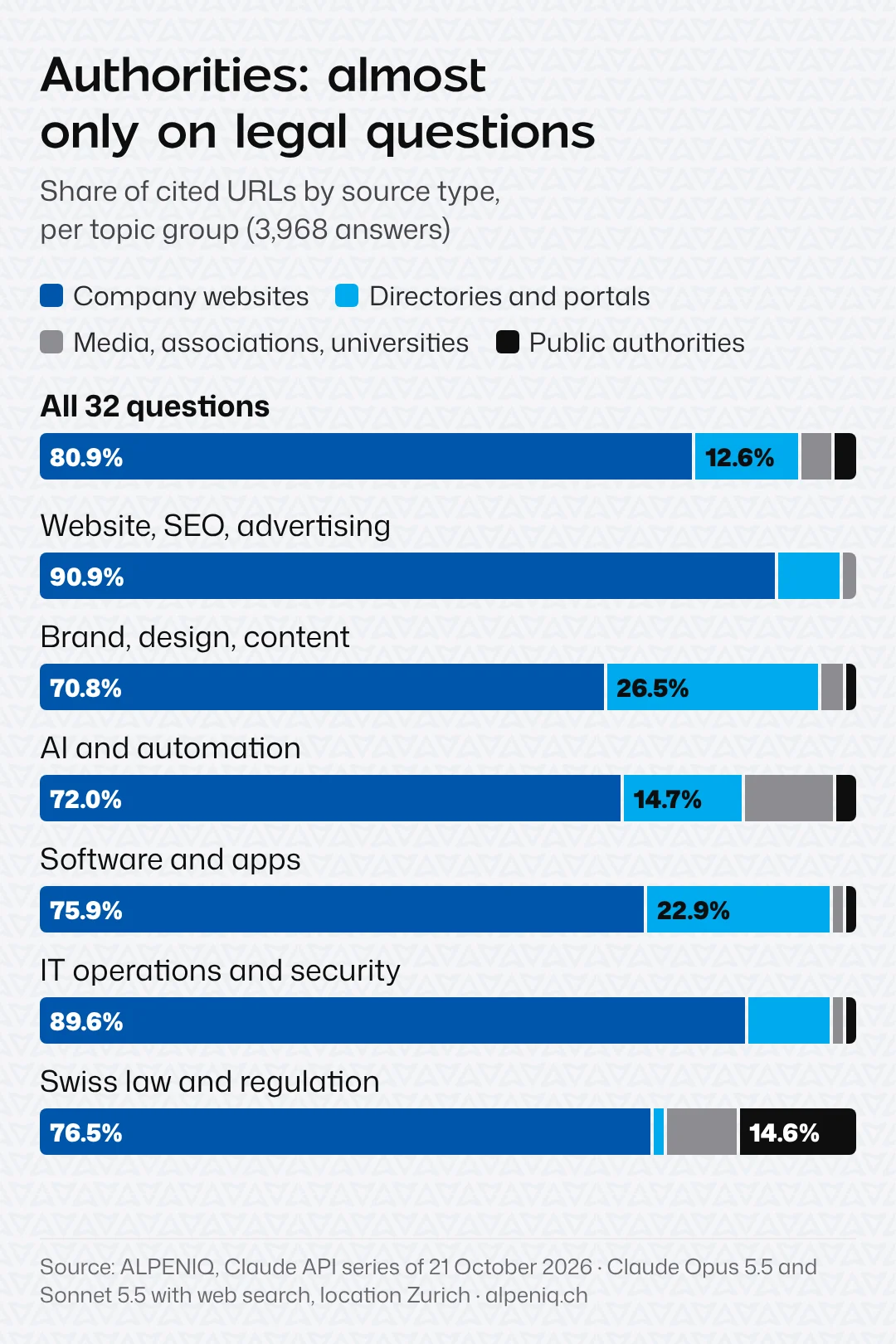
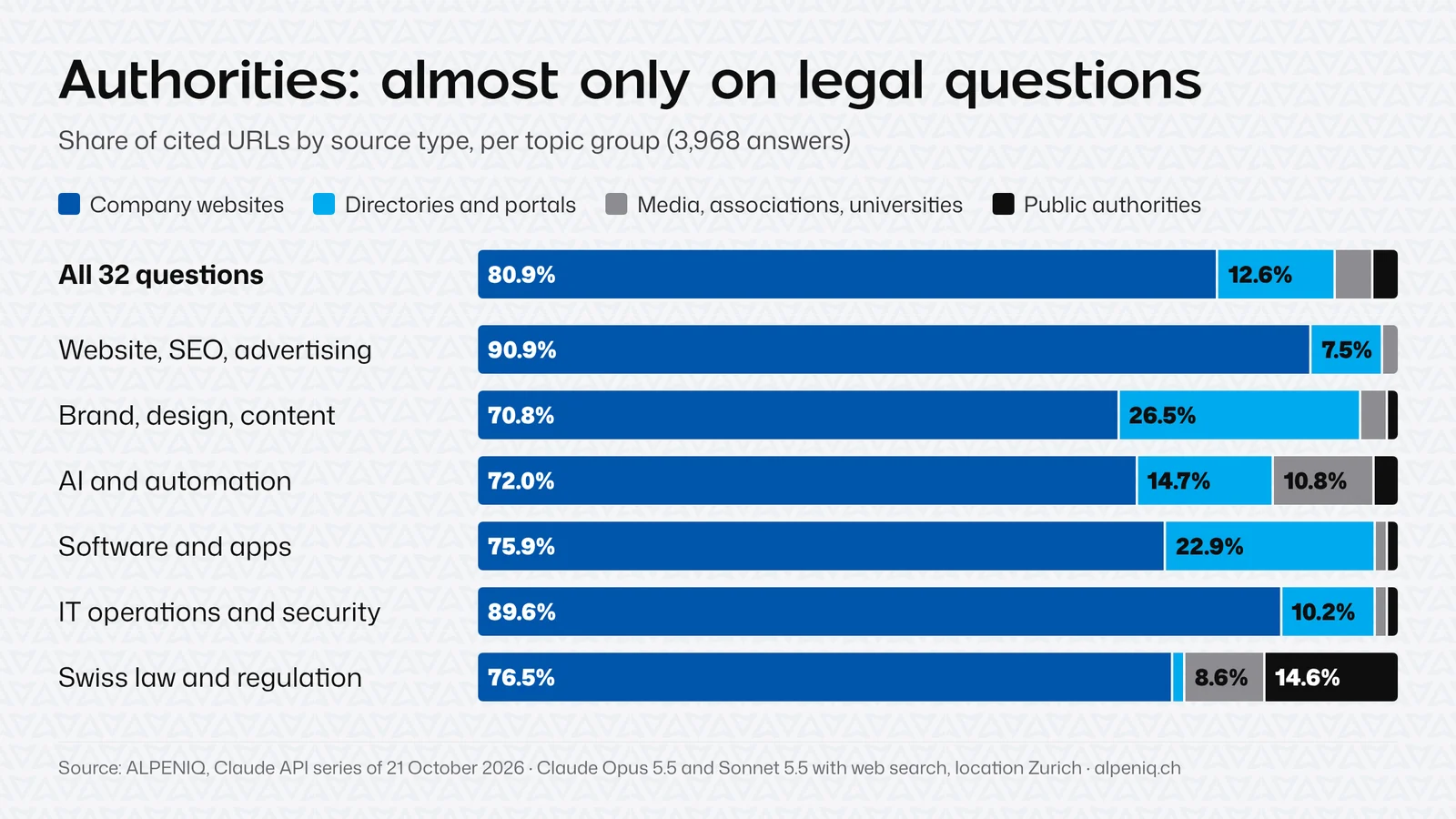
Of 26,933 cited addresses, 80.9% belong to businesses: agencies, IT providers, software houses, hosting companies. The share peaks for website, SEO and advertising at 90.9% and for IT operations and security at 89.6%.
Editorial and public sources are rare. Media, associations and universities supply 3.7% of addresses, public authorities 2.7%. Only on Swiss legal questions do authorities reach 14.6%. When asked who has to report a cyberattack, every single answer cited a federal page on admin.ch, in both languages.
| Topic group | Company websites | Directories | Media, associations | Authorities |
|---|---|---|---|---|
| All 32 questions | 80.9% | 12.6% | 3.7% | 2.7% |
| Website, SEO, advertising | 90.9% | 7.5% | 1.6% | 0.0% |
| Brand, design, content | 70.8% | 26.5% | 2.7% | 0.0% |
| AI and automation | 72.0% | 14.7% | 10.8% | 2.5% |
| Software and apps | 75.9% | 22.9% | 0.3% | 0.9% |
| IT operations and security | 89.6% | 10.2% | 0.1% | 0.1% |
| Swiss law and regulation | 76.5% | 0.2% | 8.6% | 14.6% |
Claude also goes to company websites for explanations. At least 20.6% of all addresses are guides or blog posts published by companies, and 4.3% are rankings along the lines of "the best agencies". The guide share is a floor: we detect it from the URL path, and many guide pages have no /blog/ in their address.
Directories decide entire topic groups
When a question asks for a provider, more than half of the answers cite a directory or comparison portal: 53.9%. How strongly depends on the field.
| Topic group | Answers citing a directory |
|---|---|
| Brand, design, content | 78.8% |
| Software and apps | 72.0% |
| IT operations and security | 59.1% |
| AI and automation | 32.7% |
| Website, SEO, advertising | 26.5% |
| Swiss law and regulation | 1.3% |
In IT operations and security, a single Swiss provider directory, it-provider.ch, appears in 48.8% of answers. The pattern is stronger in English: 44.2% of English answers cite a directory, against 33.6% of German ones.
What might follow, as a hypothesis: a complete profile on the directories in your field is the obvious thing to test. We have not measured whether it leads to mentions. What the data shows is where the sources come from, not what they cause.
No source dominates, but every question has its own
Open the chart in portrait format
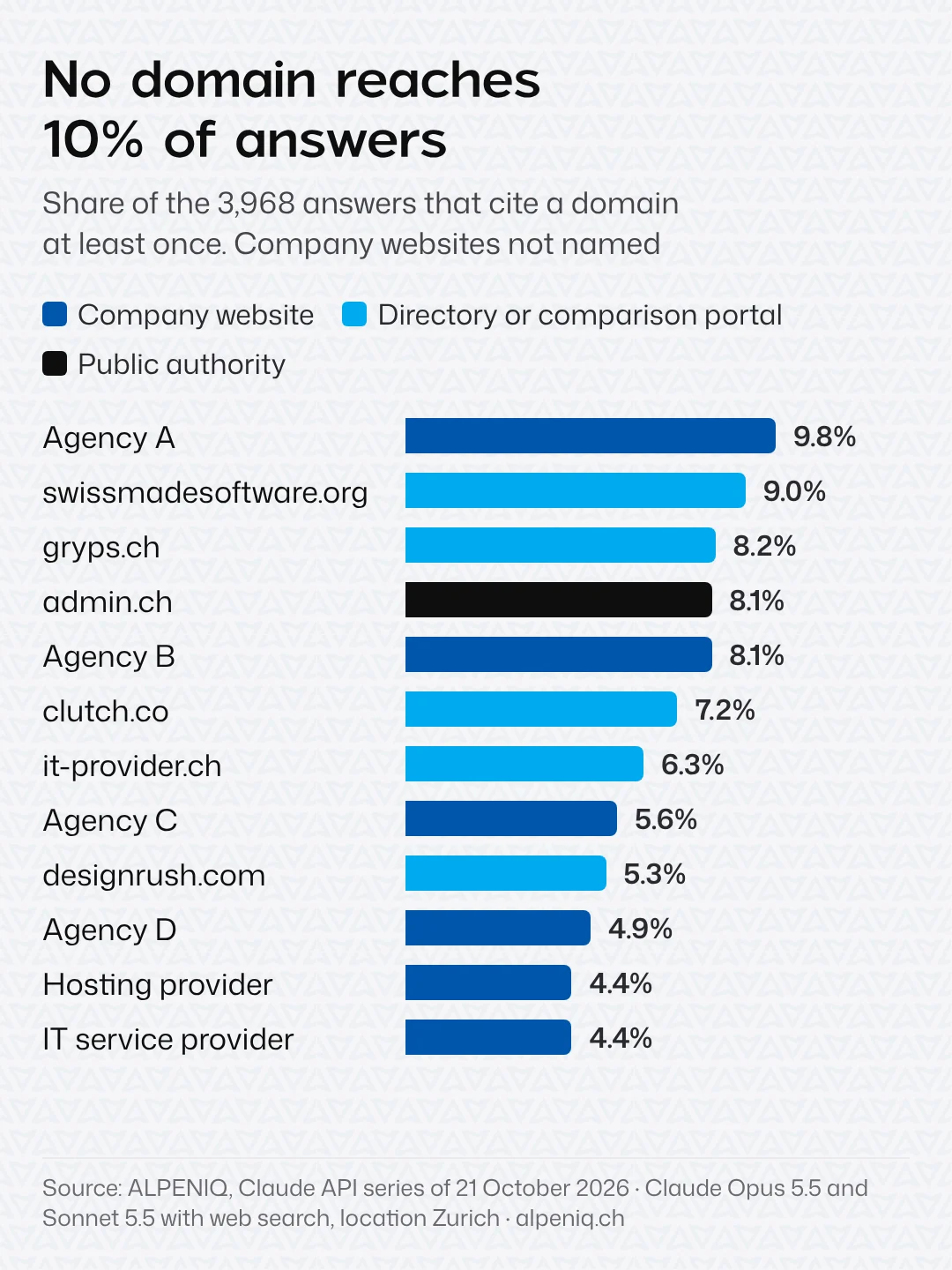
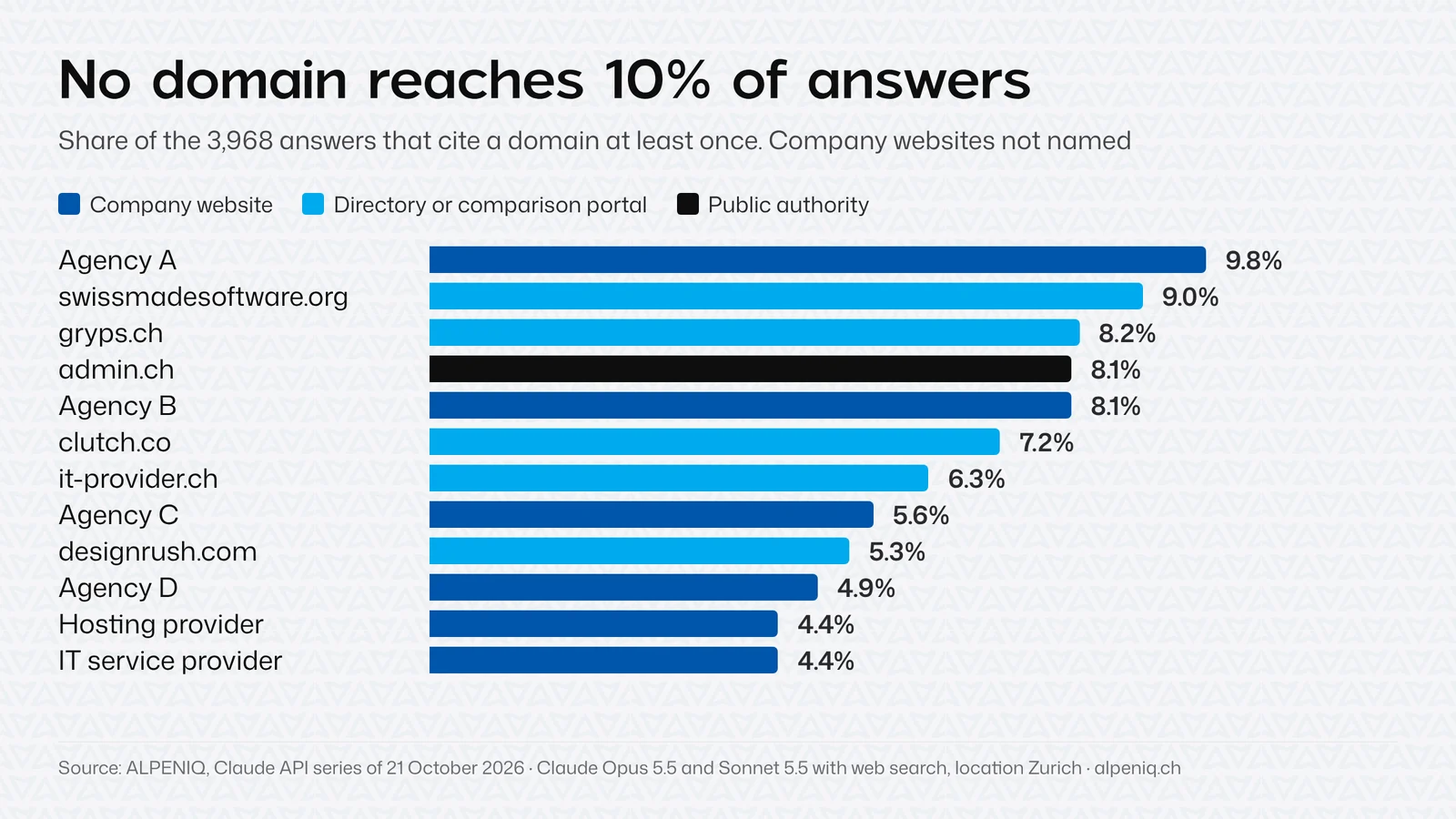
The most-cited domain appears in 9.8% of answers. The top ten together make up 12.0% of all domain citations. It takes 100 domains to cover half, and 176 domains were cited exactly once.
| Domain | Share of answers | Source type |
|---|---|---|
| dlm-digital.ch | 9.8% | Company website |
| swissmadesoftware.org | 9.0% | Directory |
| gryps.ch | 8.2% | Directory |
| admin.ch | 8.1% | Authority |
| beyondweb.ch | 8.1% | Company website |
| clutch.co | 7.2% | Directory |
| it-provider.ch | 6.3% | Directory |
| webtree.ch | 5.6% | Company website |
| designrush.com | 5.3% | Directory |
| brandaffairs.ch | 4.9% | Company website |
| hostpoint.ch | 4.4% | Company website |
| mtf.ch | 4.4% | Company website |
Across all questions, the citation core is broad. Per question, it is narrow. In 87 of 121 measurement cells, the same domain appeared in every answer that cited any source at all. A cell is one question in one language on one model; only cells with at least two such answers are counted. For the German question about branding agencies, all 62 answers cited the same agency domain.
For a small business, that means visibility is not won on average. It is won one question at a time, as our own case below shows.
Swiss legal questions, German sources
Open the chart in portrait format
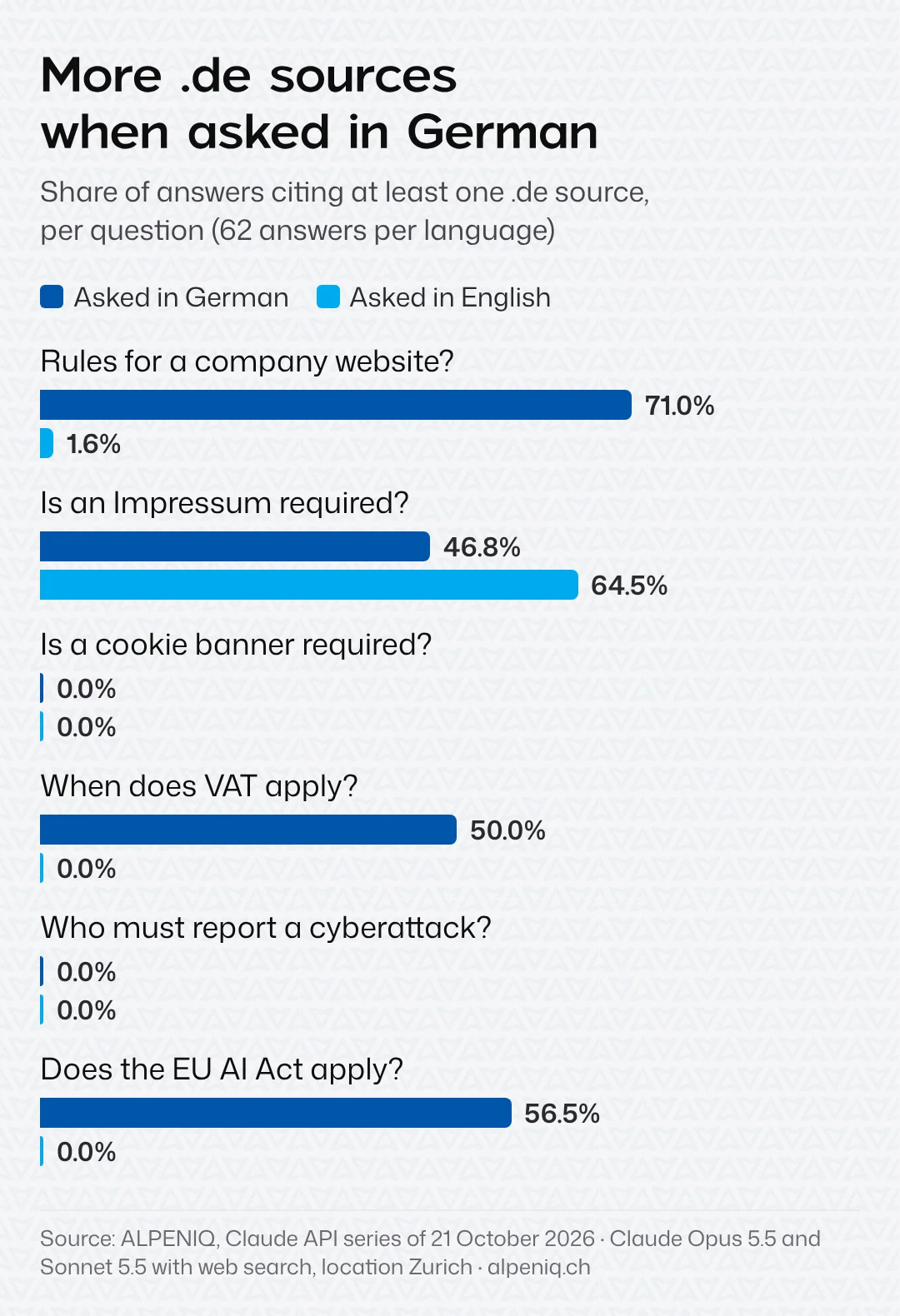
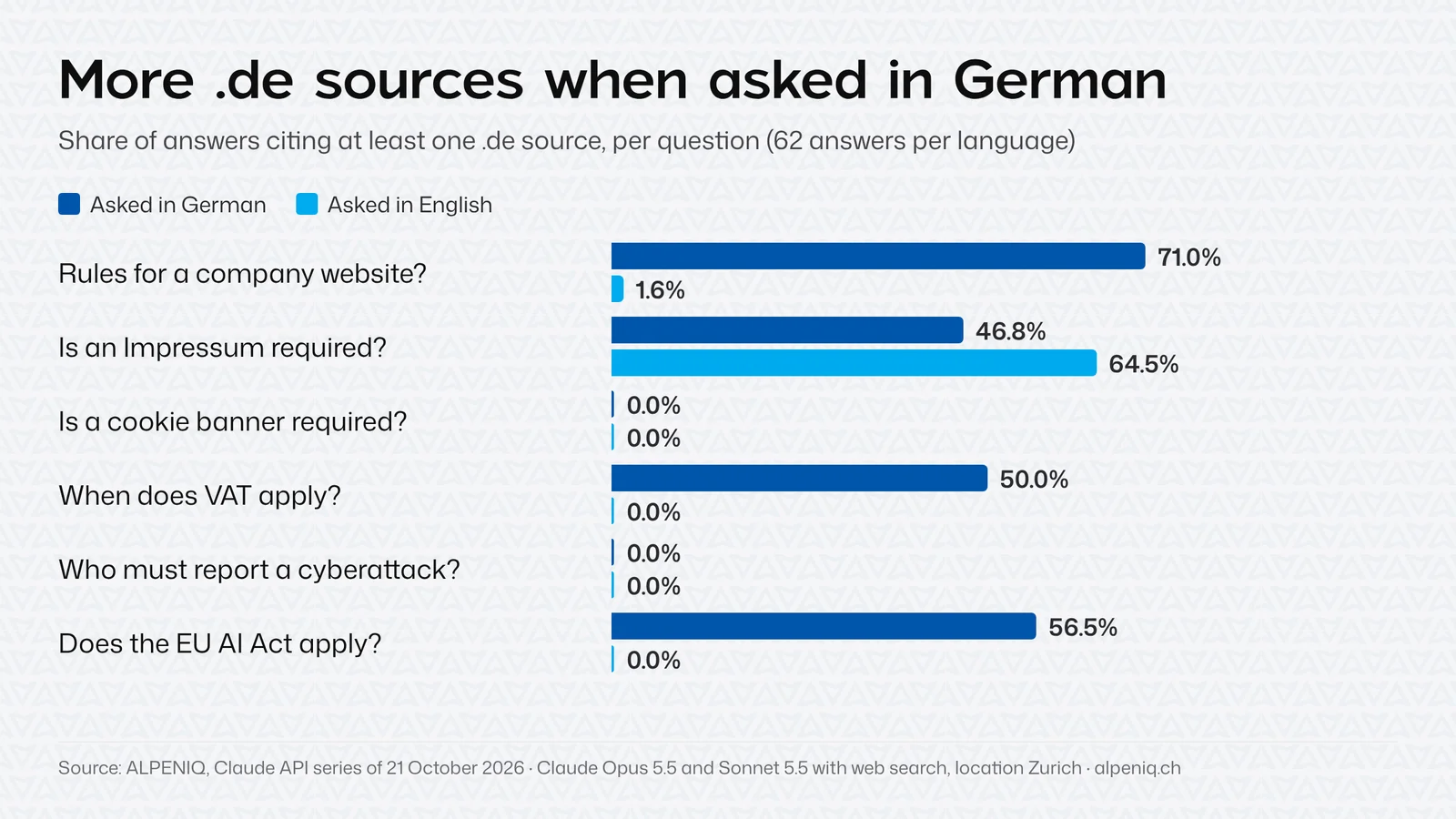
Across the six questions on the Swiss legal framework, 37.4% of German-language answers cited at least one source with a .de ending. In English it was 11.0%. Measured by the addresses themselves, the share stays small: in the German answers of this group, 8.8% of cited addresses are on .de and 69.2% on .ch.
The effect is strongest for the broadest question, what rules apply to a company website in Switzerland: 71.0% of German answers and 1.6% of English ones. The most frequent .de domains in the German answers of this group were it-recht-kanzlei.de at 10.2%, redegold.de at 9.7% and haufe.de at 8.3%.
| Question | German | English |
|---|---|---|
| Rules for a company website? | 71.0% | 1.6% |
| Is an Impressum required? | 46.8% | 64.5% |
| Is a cookie banner required? | 0.0% | 0.0% |
| When does VAT apply? | 50.0% | 0.0% |
| Who must report a cyberattack? | 0.0% | 0.0% |
| Does the EU AI Act apply? | 56.5% | 0.0% |
Two details are worth noting. For the Impressum question, the English version is affected more than the German one. And in German, Claude searched the web for that question in only 48.4% of answers.
A .de ending is a blunt signal. A German page can explain Swiss law correctly, and German content also lives on .com addresses. What we measured is where the source comes from, not whether the answer was wrong.
Without a location, Claude rarely searches
Two of the 32 questions mention no place: "why is my website not bringing in customers" and "google ads vs seo for small businesses". For these, Claude ran a web search in 6.5% of answers. For the 30 questions with a location, it did so in 98.5%.
No search means no source that could be won. For the Google Ads versus SEO question, 93.5% of German answers also mentioned the euro; for the second question without a place, it was one in 62. The Zurich location was set. Whether it has any effect without a search, we did not test.
Two questions are a narrow basis. The gap is large, but it holds for these two phrasings, not for every question without a place. How SEO and Google Ads compare for Swiss SMEs is covered in a separate article.
German and English are two different markets
Language shifts the sources more than the model does. Of the ten most-cited domains per question, German and English share 2.1 on average. Opus and Sonnet share 5.8. Both values assume that ties for tenth place are broken alphabetically; across every possible tie-break they range from 2.1 to 2.3 and from 5.4 to 6.1.
In German, Swiss providers and platforms lead the list; in English, international directories do. 85.6% of German citations point to a .ch address, against 59.1% of English ones.
| Rank | German | English |
|---|---|---|
| 1 | gryps.ch, 13.3% | clutch.co, 14.4% |
| 2 | beyondweb.ch, 10.9% | swissmadesoftware.org, 14.2% |
| 3 | dlm-digital.ch, 10.8% | designrush.com, 10.6% |
| 4 | webtree.ch, 8.9% | dlm-digital.ch, 8.7% |
| 5 | admin.ch, 8.4% | techbehemoths.com, 8.0% |
If you serve clients in English, the English version of a page competes in a different field from the German one.
How random are the answers?
Language models do not answer the same way twice. We measured how much that affects the sources by comparing every answer with a source against every other answer with a source in the same cell: 57,780 pairs across the 121 cells above.
Only 20.9% of pairs cited exactly the same domains. The average overlap of two source lists was 0.59 in the median cell, measured as the share of shared domains among all domains in both answers. Across all citing answers in a cell, a median of 16 different domains came up.
The main source for a question is stable; the rest changes. That is why a single answer from Claude is not a measurement. If you want to know whether you get mentioned, you have to ask the same question many times. Why a Google ranking is not enough on its own is covered in SEO for the AI era.
Where ALPENIQ stands
We hold ourselves to the same count. ALPENIQ appears in 2.5% of the analysed answers, 101 out of 3,968.
Nearly all of it comes from one question: "how much does a professional website cost in switzerland". There, 100% of German Opus answers and 94.7% of German Sonnet answers mentioned or cited ALPENIQ; in English it was 91.7% and 31.6%. All 94 citations point to the same article, what a professional website costs in Switzerland, in its German version, including in the English answers.
For the 20 questions that look for a provider, Claude cited alpeniq.ch in none of 2,480 answers. Our name did appear in the text of 7 of them, each time without alpeniq.ch as a source. In the website, SEO and advertising group we reach 8.1%; in every other group, between 0 and 0.2%.
That is our baseline. We publish it because a study that only shows its publisher's good numbers is not a study.
What this may mean for a Swiss SME
This study shows whom Claude trusts. Whether any of the following steps leads to more mentions has not been measured. They are tests that follow from where the sources come from:
- A page that answers the question. For the German cost question, the winning page in our data matches the question almost word for word. How to find questions like that is covered in our article on website copy.
- Maintain directory profiles. In four of six topic groups, between 32.7% and 78.8% of answers cite a directory.
- Explain Swiss law with Swiss sources. For four of the six legal questions, between 46.8% and 71.0% of German answers cite a .de page. Whether a Swiss explanation would be cited there instead is an open question.
- Think about place and language. Questions with a location almost always trigger a search, and German and English cite different sources.
For how terms like GEO and AI SEO fit together, see our overview of AI visibility. How we work on AI visibility for clients is on our SEO page, and for the local angle, our article on local SEO in Switzerland.
Limits of this study
- One platform, two models. Applied to ChatGPT, Gemini or Google, these findings are a hypothesis.
- One day. Sources change; this measurement describes 21 October 2026.
- About one search per answer. Claude searched 1.05 times per answer on average. More thorough research would surface more sources.
- 36 questions chosen by ALPENIQ. The selection follows our offering and is not representative.
- Source type by rule. The directory and media lists were checked by hand for every domain with at least 15 answers. Rarer domains are classified by the rules alone.
Download the data
Every figure in this article is in a CSV file: ki-sichtbarkeit-schweiz-2026-10.csv, one metric per row with group and unit. We do not publish the answer texts themselves, because they reproduce third-party content.
Before publication, a separate reviewer recalculated every number from the raw data.